Projects
A short history of projects in which I've lent a hand or played some
significant role.
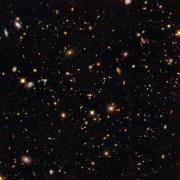
DEEP and EGS related projects
The DEEP (Deep Extragalactic Evolutionary Probe) team consists of
members principally from UC-Santa Cruz and UC-Berkeley, with
participating members worldwide. Using the DEIMOS spectrograph at
Keck, the team has taken high-quality spectra of over 15,000 objects
at intermediate to high redshift (0.75 < z < 1.5, roughly), one of the
largest high-redshift surveys to date. In addition, DEEP is now one of
the organizing teams in the Extended Groth Strip (EGS) team (working
group name AEGIS), which consists of members from the IRAC team at
CfA, the Chandra team, the GALEX team, and many others. The AEGIS team
was formed to pool multi-wavelength data for objects in the EGS and to
make these data available to all members in the group with a level of
accessibility very rare in such large-scale collaborative science.
I do not work on the data side of either of these groups, but am
attached to the DEEP group in working with stellar population
modeling. At present, I am working on a number of projects that
attempt to characterize the histories of various classes of galaxies,
in particular, the creation of the red sequence.
See here for some relevant links and tools
I've worked on for DEEP.
Status: Ongoing. One first-author publication to date, on work done
with Ricardo Schiavon in measuring the Balmer line equivalent widths
for red sequence galaxies. We found that the spectra at low
redshift were inconsistent with uniformly old stellar populations and
that furthermore they were inconsistent with the high redshift
population under the assumption of a single age. By creating a
population of "quenched" galaxies (blue, star forming galaxies that
are shut off entirely at some prescribed time) that formed at a
uniform rate in time, we were able to fit the average red population
to the line data, as well as U-B color and red sequence number density
from DEEP2. The article will be published as a letter in an upcoming
volume of ApJL. An electronic version may be found at astro-ph. Click here
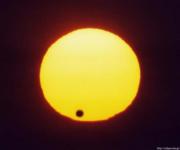
Transit Search (P.I. Greg Laughlin)
Relying on photometry from a distributed network of skilled backyard
astronomers, we plan to attempt to detect the little blips on light
curves that occur when a planet passes in front of its parent
star. Our target list comes from the working list of extrasolar
planets, for which we have known orbital elements, as well as RA and
Dec for the host star. Work to date includes a monte carlo simulation
(initially authored by Scott Seagroves) which demonstrates the feasibility of
said campaign.
Status: Though my involvement in transitsearch is over, there is now a
small but working network who have made a handful of observations, and
the group is currently taking all applicants with proper equipment!
Check out the main site: TransitSearch.org Also, a
paper detailing the monte carlo simulations has been published in the
PASP, and can be found on astro-ph: click here
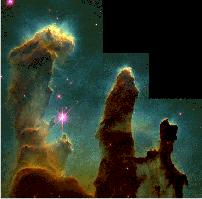
Evolution of molecular clouds in the Eagle Nebula (P.I. Greg Laughlin)
In the Eagle Nebula, there is a structure which resembles a set of
three pillars. These are essentially giant plumes of hydrogen, helium
and assorted other molecular gasses and dust, seeded with stars that
have formed over the last few million years. These clouds are slowly
evaporating and would appear to be "boiling" if we could fast-forward
the universe to several million times its current speed. This project
attempted to do just that. Using an MHD code, we
simulated M16's future for several million years.
Status: Dead. It was a fun project, but the code did some buggy things
with the boundary conditions and it did not handle the full MHD
treatment in a
realistic way. Also, we never came up with a particularly great way to
figure out what the 3-d density map should look like. Ultimately, when
I decided on a different project for
my department-required second year project, this got stashed more or
less permanently.
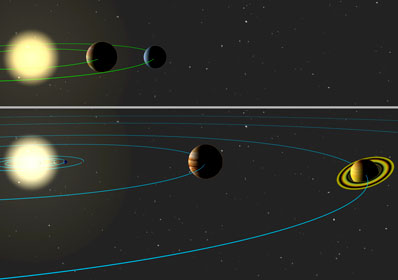
Stability tests for planets close to 3:1 resonance (P.I. Doug Lin)
Two jupiter-like planets are discovered near 3:1 resonance close to
the parent star (with periods of order tens of days) meaning tides and
even GR may be important. This work was meant to test whether the
predicted
orbital elements result in a stable configuration by basically using
shadow orbits and integrating over extremely short times to determine
whether different orbital configurations are preferred.
Status: Done, I guess. Results were published somewhere, though I
didn't have anything to do with the finished product.
The rest of this stuff is work from my undergrad days at UW-Madison
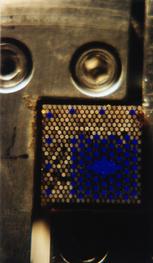
Sparsepak: A fiber optic cable (IFU) for use on the WIYN telescope
(P.I. Matt Bershady)
Over the course of about 1½ years, I helped build an integral
field unit, or IFU (basically a neat way to get spectroscopy for an
object in two dimensions at once, as opposed to slit-based
spectroscopy which allows you to get an object's spectrum along only
one spatial dimension), used to pipe light from the
WIYN telescope to
the bench spectrograph in the basement.
After a full summer of running 100-pound sections of cable up seven
flights of stairs (in a 90-degree humid Wisconsin summer, no less)
numerous occasions
where we got about 6 or 7 random astronomers and shop guys to help
coil and uncoil the 25 meter metal and glass python, and one winter of
gluing, polishing and testing optic fiber, we finally got it into
shape.
Status: Done, and producing good science! The cable is now in regular
use on the telescope at Kitt Peak National Observatory outside Tucson,
AZ.
FRD and throughput tests for 500-micron optic fiber (P.I. Matt
Bershady)
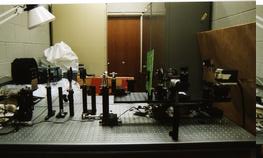
I was responsible for testing the characteristics of the optic fiber
used in Sparsepak the summer after it had been shipped out. Same setup
was used to test Sparsepak itself (testing done almost exclusively by
Dave Andersen). Basic testing scheme was to align the elements on the
optic
bench (collimating lenses using lasers and fun stuff) for hours or
sometimes days, then perform tests for FRD (focal ration degradation, a
phenomenon caused by irregularities in the surfaces of optic fiber) and
throughput (the percent of light that makes it through 25 meters of
cable at some given wavelength). Another related experiment
(unpublished) was a test of my ability to sit in the dark for hours on
end without letting my irrational fear of spiders and centipedes and
scorpions get to me. (Only one panic attack the whole
summer!)
Status: Done, paper is avaiable at astro-ph:
click here
UW-Physics Dept: Argon cross-sections from electron impact
excitation (P.I. C.C. Lin)
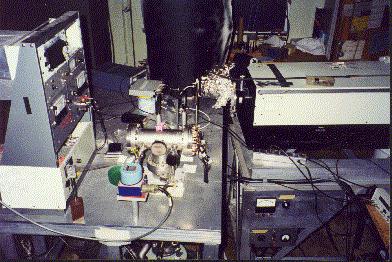
I sat in a dark room for the better part of a month and a half playing
around with liquid nitrogen, a very very old computer, and some
argon. The idea is, you fire an electron gun into a cloud of argon,
and look for a specific wavelength of light that corresponds to a
specific atomic tranistion from one of ten 3p states to one of four 1s
states. Use of a sensitive PMT required spooky levels of darkness in
the room, where the only light was provided by Randomly Flashing
Science Things.
Status: Done, but I probably won't be credited in the publication,
since this was a minor part of the experiment, and I was an
undergrad. Yay!
Also UW-Physics: Barney, the coultron ion accelerator
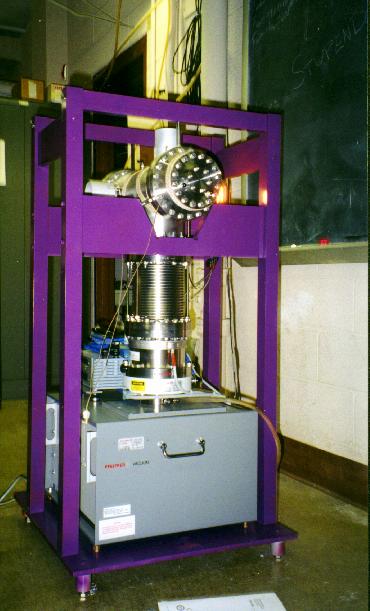
This coultron ion source was designed for the MOT experiment. The
experiment was using an electron gun to excite the rubidium atoms in
the trap, but this was complicated since electrons are small, and
easily pushed around by any residual magnetic fields that can't be
shut off in time. By using ionized helium or argon, however, you don't
need to worry about the fields as much, since the ions are too heavy
to push around, and tend to stay on target. This is actually one of
many random apparatuses I built for the various labs run by the Atom Weasels at
Madison. However, it's the biggest, and to my knowledge the only one I
have a picture of. Except here, you can
barely see a little box sitting under the table. It's the smallish one
with four switches on the front and several dials on top. It was
designed to provide four variable offset, variable length square waves
to... some other random part of the experiment I guess. Trust me when
I say it's more awesome than any other box ever built for research
purposes whatsoever. (Including even the Hubble Space Telescope and
those transporter things from The Fly that turned Jeff Goldblum
into a bug.)
Status: Done and working in one of the Atomic Physics group
labs.
Barney was built under the supervision of then-postdoc Len Keeler, who
is now the entire physics department at UW-Superior (edit: as of sometime
mid-2002, this is no longer true. Presumably Len has vanished
into the mists somewhere).