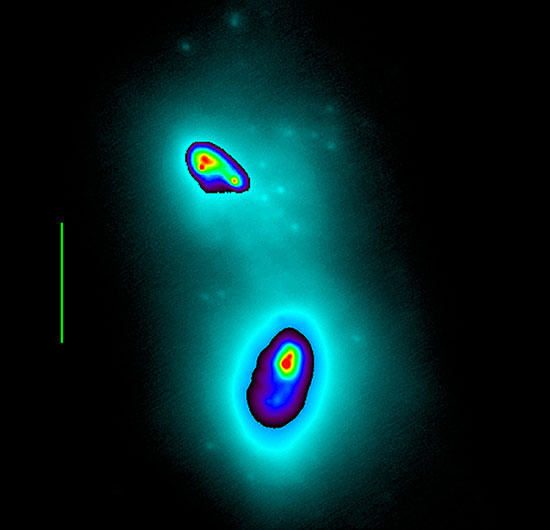
Colliding Galaxy Nuclei Detail NGC 6240 is an ongoing collision of two gas-rich disk galaxies. Using adaptive optics at the Keck II Telescope, University of California researchers have resolved young star clusters formed because of the merger (small blue dots), and have identified which features within the twin nuclei are associated with the two supermassive black holes known to inhabit the nuclear regions. In this image taken in infrared light, the nucleus from each of the two galaxies is shown using a color scheme that emphasizes the detail within the nuclei. The green vertical line represents one second of arc, or 1600 light years at the distance of NGC 6240.
Credit: C. Max, G. Canalizo, W. de Vries
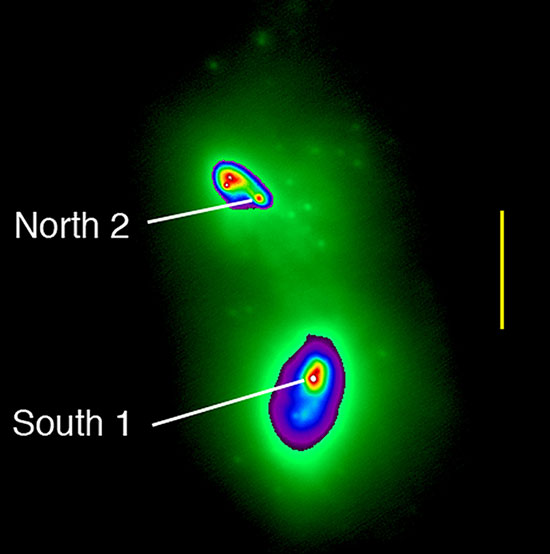
Colliding Galaxy Nuclei in IR light This is a variation on item (1) above
An adaptive optics image of the double nucleus of the galaxy merger NGC 6240, taken in infrared light with the Keck II Telescope. The feature within the north nucleus labeled "North 2" is at the position of the northern supermassive black hole. The southern supermassive black hole is located just north (above) the feature labeled "South 1" in the south nucleus. The yellow vertical line represents one second of arc, or 490 parsecs at the distance of NGC 6240.
Credit: C. Max, G. Canalizo, W. de Vries