For the next week "we" will look at one of the most fundamental questions about a star:
How does a star produce all the energy that it radiates away into space?
The answer to this explains the existence of the main sequence in the H-R Diagram and leads into the next big topic - the formation and evolution of stars.
So, a 3000 gram bucket of coal is good for about 1.2 x 10¹⁶ ergs or 300 Kilowatt-hours. This would run a little space heater for about an hour.
Now, the Sun's mass is 2 x 1033 grams. If the sun was made of
coal and producing energy via conventional combustion, it could generate a
total energy of:
Lifetime is calculated by taking the total energy available divided by the rate
at which you are using up the energy. The sun uses up energy at a rate of
  1 L
= 4 x 1033 ergs/sec.
| Lifetime | = | 8 x 1045 ergs   x   | 1 sec |
||||||
| 4 x 1033 ergs | |||||||||
|   | |||||||||
| = | 2 x 10¹² secs   x   | 1 min |
  x   | 1 hr |
  x   | 1 day |
  x   | 1 year |
|
| 60 sec | 60 min | 24 hr | 365 days | ||||||
|   | |||||||||
| = | 6300 years |
is equivalent to 1 ton of
coal burned per hour for every square foot of the Sun's surface
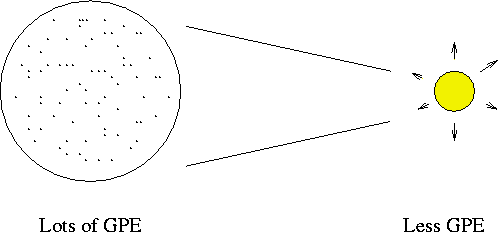
Anytime you have a collection of mass (for example a gas of atoms and molecules), it has an associated Gravitational Potential Energy - GPE. For a big ball of gas, the GPE goes like:
| GPE   =   - | 3 |
  x   | M2 |
  x   | G |
| 5 | R |
where R is the radius of the ball of gas, M is the total mass, and G is the "gravitational constant".
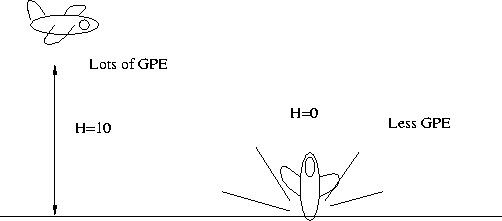
Similarly, because the Earth exerts a gravitational pull on objects at its
surface and in space, these objects all have an associated GPE.


How much total GPE does the Sun have that could be turned into radiation as the Sun shrinks?
| GPE   =   | 3 |
  x   | M 2 |
  x   | G |   ~   2 x 1048 ergs |
| 5 | R |
This shows that converting GPE is a pretty efficient process compared to chemical burning:
| 2 x 1048 ergs |
  =   1015 ergs/gram |
| 2 x 1033 grams |
This is about 250 times more efficient than chemical burning.
| Lifetime   =   2 x 1048 ergs   x   | 1 sec |
  =   5 x 10¹⁴ sec |
| 4 x 1033 ergs |
This converts to 16 million years - still too short!
The Earth is around 4 billion years old (plus the Sun would have been much
bigger in the past).
would
require about 1 Earth mass per year to be accreted (not that much). This can
be ruled out because the resulting change in the Earth's orbit has not been
measured.