(University of California, Santa Cruz, Professor Puragra Guhathakurta, Professor Greg Laughlin & Marla Geha 2005-07)
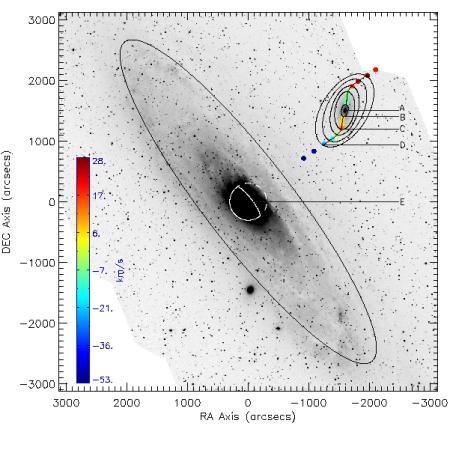
| NGC 205 is our nearest example of a dwarf elliptical (dE) galaxy, lying a projected 37 arcminutes from Andromeda (M31). Its proximity provides the means for understanding the role of dEs in hierarchical galaxy formation. Detailed photometric observations by Choi et al (2002) and kinematic observations by Geha et al (2006) suggest that NGC 205 is currently undergoing tidal disruption from its interaction with M31. Although attempts have been made to carefully understand the properties of NGC205, such as its mass and distance from M31, they are still not well known. We attempt to resolve these uncertainties by exploring the interaction between NGC 205 with M31 using a restricted N-body approach to investigate the mass and orbital parameters of NGC 205. We define our system using 10 parameters and use the tidally distorted photometric and kinematic observations as constraints. Since our constrained parameter space contains approximately 10^22 possible orbits, a genetic algorithm is employed for optimization. These simulations provide tighter constraints on the orbit and internal structure/dynamics of NGC 205. To see a movie showing the evolution of the genetic algorithm click here (requires Quicktime). This research is supported by funds from NSF and NASA/STScI. |
|
M=2 Singular Isothermal Disk Orbit Structure
(University of California, Santa Cruz, Professor Greg Laughlin & Stefano Meschiari 2004-05)
|
The orbits of stars in galaxies are quite complicated. Not only are the stars required to obey the laws of gravity dictated by the structure of their parent galaxy, they are also responsible for their mass which contributes to the gravitational potential of that galaxy. This interdependency makes the orbital structure more complicated, as well as more interesting. Specifically, we aim to study the potential of an infinitely flat disk, of constant temperature and a 2-fold symmetric departure from axisymmetry. To give an idea of M-fold symmetric departure from axisymmetry, contours of the M=1,2, & 3 potentials for the singular isothermal disk are given below: |

| Check out my presentation from November 2004: |
For more information, take a look at Greg and Stephano's webpages: Stefano Meschiari's Homepage (In Italian) Greg McLaughlin's M=2 Isothermal Disk Homepage |
Cosmic Strings
(Lawrence Berkeley National Laboratory, Professor George Smoot 2003-2004)
|
The resurgence of interest into cosmic strings is fueled by the discovery of identical, aligned galaxies at z=0.46 (Sazhin 2003). It is hypothesized that these strings were created during a phase transition in the early universe. The existence of light cosmic strings would result in gravitational lensing of background sources and would produce identical, aligned images approximately 5 arcseconds apart. Although the presence of cosmic strings is unconfirmed, deep field surveys offer an excellent resource for probing distant regions. In particular, we are looking at the GOODS data provided by the Hubble Space Telescope in order to confirm or statistically negate the existence of cosmic strings. To see our poster on cosmic strings, click here For more on cosmic strings, click here
|

Weak Gravitational Lensing
(University of California, Berkeley, Professor George Smoot 2002-2003)
|
Weak gravitational lensing provides direct information about the dark matter distribution in the universe by causing weak distortions in background images. Various methods have been developed to measure the degree to which background objects have been lensed. These mathematical methods include the Kaiser Squires & Broadhurst (KSB) Method, Shapelets Method, and Rhodes Refregier & Groth (RRG) method. Using these tools, the mass distribution of the lensing cluster can be reconstructed, thus revealing the dark matter distribution. Once mass maps are created, further information about the structure of our universe can be gathered, such as the dark matter power spectrum, tightly constrained cosmological constants, and the dark energy distribution. For more on weak gravitational lensing, click here |

Gravitational Lensing by a Simulated Point Source. The strength of the field has been exaggerated to visually demonstrate the effect of lensing. Typically, lensing of this strength would be referred to as strong lensing; the shear associated with weak lensing is on the order of 2-3%.