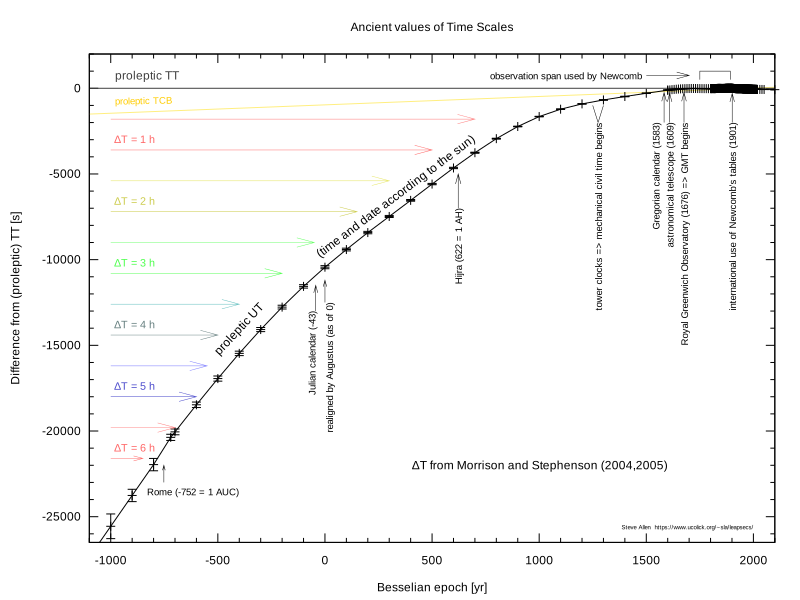
There are several points to make within these plots.
Wikipedia has details on the
Augustan realignment of the Julian calendar and the
cessation of the intercalary month in the Islamic calendar
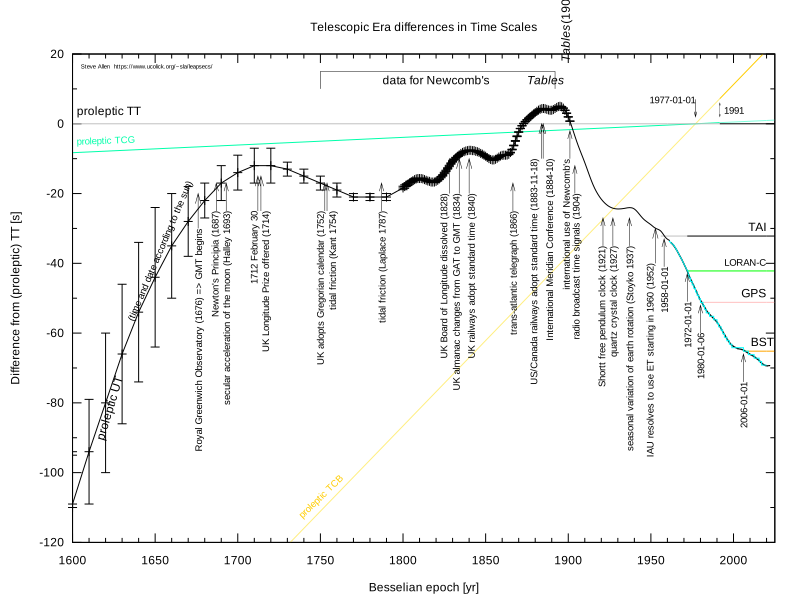
In the previous plot it is evident that the form of Delta T has been roughly parabolic. This is consistent with a roughly linear increase in length of day (LOD). The next plot shows details of the vertex of the parabolic form.
On both plots I show the span of the observations which were used to produce Simon Newcomb's Tables of the Sun for the US Naval Observatory. Celestial navigation was strategic, and Newcomb had the resources of the US federal government behind his efforts to analyze observations of the moon and planets. Newcomb and his team of computers reduced more than 60000 observations, along with input from other observatories.
In 1896 the directors of the principal national ephemerides met in Paris. They recognized that Newcomb's tables exceeded any other effort, and they decided that all ephemerides would begin to use Newcomb's expressions starting in 1901. As a result of that decision Newcomb's tables produce the form of the plots that we see here.
The choice of Newcomb's tables meant that the length of the ephemeris day, and thus later the ephemeris second and the SI second, was roughly equal to the mean length of day over the span of observations used by Newcomb, or roughly 1820. That guaranteed that whatever the functional form of Delta T might be, it would have a slope of zero around 1820. The choice of starting to use the tables in 1901 meant that whatever the functional form of Delta T might be, it would have a value of zero around 1901.
Of particular note in the plot above is the inception of GMT.
The Royal Greenwich Observatory was not constructed until 1676.
Any time scale which counts elapsed time since 1601 cannot correspond
to time scales which were in contemporary use.
(Indeed, any time scale extrapolated back prior to 1955 may have to
specify whether it is counting the non-uniform solar time which was in
contemporary use, or some more uniform time which matches a modern
interpretation.)
Wikipedia has details on
February 30, and I hardly dare to mention
other
aspects of the switch from Julian to Gregorian calendars.
Relativistic variation of TCB and TDB exaggerated by factor of 1000.
Note distinction between astronomical time scales (nearer top)
which are based on physics of planetary motion
and time scales in practical use (nearer bottom)
which are based on earth-based measurements.
Most applications use TDB instead of TCB.
Most applications use TT (really TAI, but practically UTC)
instead of TCG.
Note that TCB is in some sense the most uniform time scale on these plots, for it is the rate of time measured by an observer moving with the solar system but not affected by the relativistic effects of orbital motion and gravitational fields. There are, however, no clocks in a position to tick at the rate of TCB.
TDB runs at a rate defined to match the current rate of TT, and as such it is suitable for calculating planetary ephemerides, but the motion of the earth around and within the gravity well of the sun leads to an annual variation with an amplitude of about 2 milliseconds.
Therefore these plots choose TT (effectively equivalent to ET which was based on the non-relativistic tables of Newcomb) as the zero point, for that it a uniform timescale that best correponds to measurements made by the chronometers that humans have built and operated on the surface of the earth.
Througout most of history, however, humans have used chronometers for the purpose of matching the position of the sun in the sky. As such the clocks used for civil purposes have always followed the roughly parabolic form of UT -- the rotation of the earth. It has only been since the 20th century that there has been any use of time scales which are "more uniform" than the time of day indicated by the rotation of the earth.
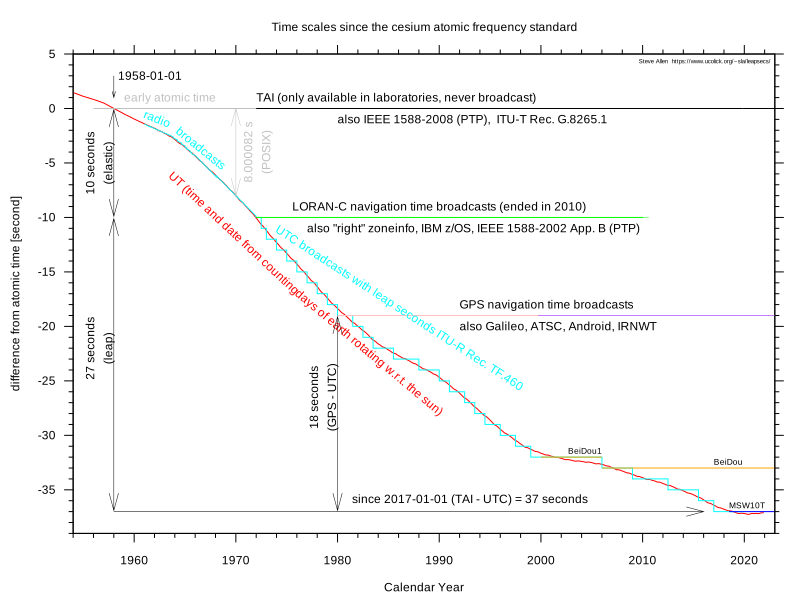
All of the straight and level time scales in these plots were created and disseminated for the purposes of navigation. Until now the broadcasts of time signals have recognized that the needs of human navigators and the general public supersede the needs of machines for predictably uniform time.
Recently we have seen civil authorities changing the civil time by hours to support notions such as the 2000 Olympics in Australia, the unproven saving of energy in the US, or the whims of Hugo Chavez in Venezuela. This means that computers relying on broadcasts of UTC must already have a scheme for finding the offset between UTC and civil time. In most systems this is based on some version of the zoneinfo database.
The zoneinfo database has typically been used to represent offsets of integral or half hours between broadcast time and civil time. It is capable, however, of representing offsets of seconds, and the "right" forms of the zoneinfo files have represented leap seconds.
The "right" zoneinfo files serve as an existing example of how UTC might continue to have leap seconds even if broadcast time signals abandoned them. (See here for a worked example.) This would allow everyone to have their cake and eat it too -- but only if broadcasts adopt a different name for the time scale that they are disseminating. Then the only change from current practice would be to place the leap second information into zoneinfo, making UTC into a timezone distinct from the underlying system time based on the broadcasts. All of the code complexity needed to do this is already present, and it operates in "user" space, not "kernel" space.
New -- how computers already handle leap seconds correctly. There is one working and deployed scheme which has a protocol in RFC 7808.
The relevant pieces of the POSIX 2008 specification are the definition of tzset(), and the definition of environment variable TZ (see also rationale A.4.15). The only change needed in the POSIX spec is to substitute the new name of an internationally-approved, uniformly-incrementing, atomically-regulated broadcast time scale (e.g., "TI", as the 2003 Colloquium in Torino suggested) in place of the current "UTC".
This would allow the underlying system time to increment uniformly while also allowing the calendar days presented to humans to keep pace with the sun above the rotating earth. It would remove the need for the kernel to handle leap seconds. It would remove the need for other coding hacks and code complexity which try to work around the non-uniform timing hiccup which POSIX compliance currently demands.
New -- Computers can handle leap seconds correctly. There is one working and deployed scheme and one IETF draft standard scheme.
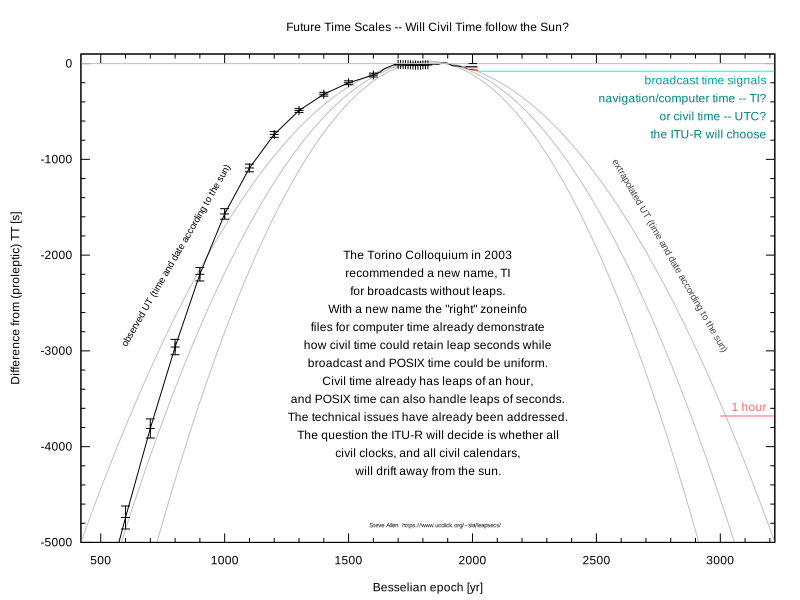
In 2003 the ITU-R subgroup investigating the future of UTC held an international colloquium in Torino Italy. The result of that colloquium recommended that a broadcast time scale without leap seconds be given a new name. (The original website was http://www.ien.it/luc/cesio/itu/ITU.shtml , but that was reorganized into http://www.inrim.it/luc/cesio/itu/ITU.shtml . Around 2011-03 the INRIM site vanished, and at roughly the same time the copies which had been in the Internet Archive Wayback Machine also vanished. As of 2011-04 the oldest archived versions from the IEN website are still in the Internet Archive. See their archive of the index page and the closing result of the colloquium.)
In the plots above and below it should be evident that if UTC
stops having leap seconds it will begin a serious departure from
what civil time and calendar days have meant throughout human
history.
If, however, the broadcast (and internet) time scale is re-named
to TI (as suggested by the ITU-R colloquium in Torino) then
computers and other systems which desire a predictably uniform
time scale can be happy.
At the same time UTC can, as far as the machines are concerned,
effectively become a time zone with the offset between TI and
UTC being described by the zoneinfo files that already give the
offset between POSIX time_t and local civil time.
A leap second is a decision by some humans to reset all of the clocks
in the world in order to comply with a longstanding convention about
the meaning of civil time.
A change in the rules for the transitions into or out of
daylight/summer time is a decision by some humans to reset all of the
clocks in some jurisdiction to comply with a change in policy
about the meaning of civil time in that jurisdiction.
These two kinds of clock resets are extremely similar, and the
zoneinfo files and POSIX rules already have the mechanisms for
handling both.
Without leap seconds, any jurisdiction which uses UTC as the basis for
its legal time will find that the ITU-R has redefined the word
"day" in their legal calendar such that the word
"day" no longer corresponds to the ongoing count of earth
rotations.
The inspiration for these plots comes from two astronomers who
have spent considerable time considering time.
In 1992
Seidelmann and Fukushima
published an explanation of why the IAU had introduced even more
new time scales in 1991 after they had already introduced new
time scales in 1976.
The following is Figure 1 from that paper.
The figure shows the differences between the different time-like arguments and time scales between 1950 and 2020. The periodic terms of TCB and TDB are magnified by 100 to make them visible. TAI is used as the reference, and ET, TDT, and TT are all taken as (TAI + 32.184 s).