Results from DEIMOS Commissioning
Observations
THROUGHPUTS
We are in the process of determining the throughput of DEIMOS in spectroscopic
mode
for all the gratings and grating tilts of relevance. What you will find
in the links below are down-
loadable plots and tables with the results of observations of the star
BD+28 4211, taken under
photometric conditions during the months of June through September/2002.
Our throughputs are defined as follows:
Throughput = Nd/Nt
where:
Nd = Number of photons detected
Nt = Number of photons hitting the telescope's primary mirror
The latter is given by:
Nt = Nst * 10 ** (-0.4*airmass*ext(lambda))
where Nst is the star's photon flux, in photon/sq.cm/s, taken from the
HST/CALSPEC
database of standard star fluxes, and ext(lambda) is the mean
monochromatic extinction coefficient
for Mauna Kea.
THE DATA
Throughput data taken with various combinations of grating tilts and order-blocking
filters
for the aluminum 600 and 900 l/mm gratings, and a more limited, preliminary
set of data for the
gold 830 and 1200 l/mm gratings are available. A more comprehensive data
set for the latter
two gratings and for the aluminum 1200 l/mm grating are in the process
of being collected and
reduced, and will be made available soon. By following the links below,
you'll be able to view plots,
or download postscript files and ascII tables with the measured throughputs.
We note that these throughputs are higher by a factor of 1.056 than the
values from an earlier
release, due to a correction in the value adopted for the collective area
of the Keck telescope.
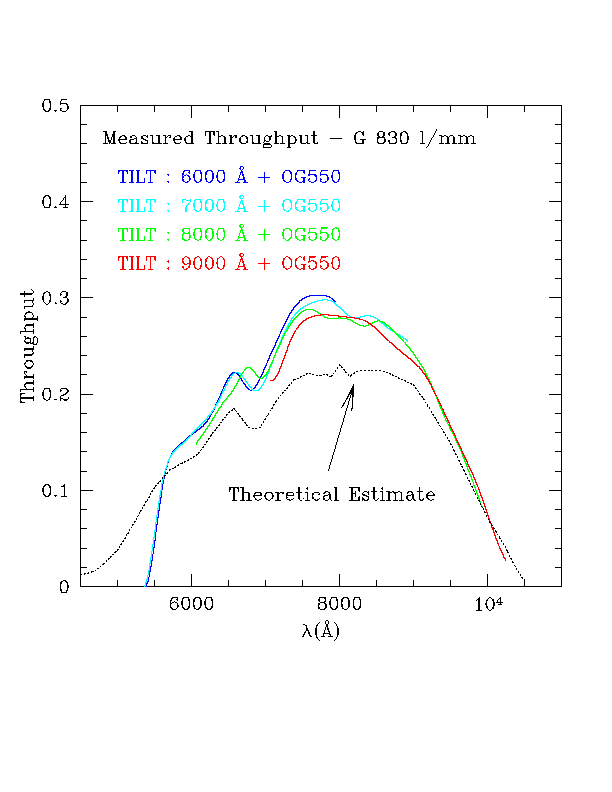
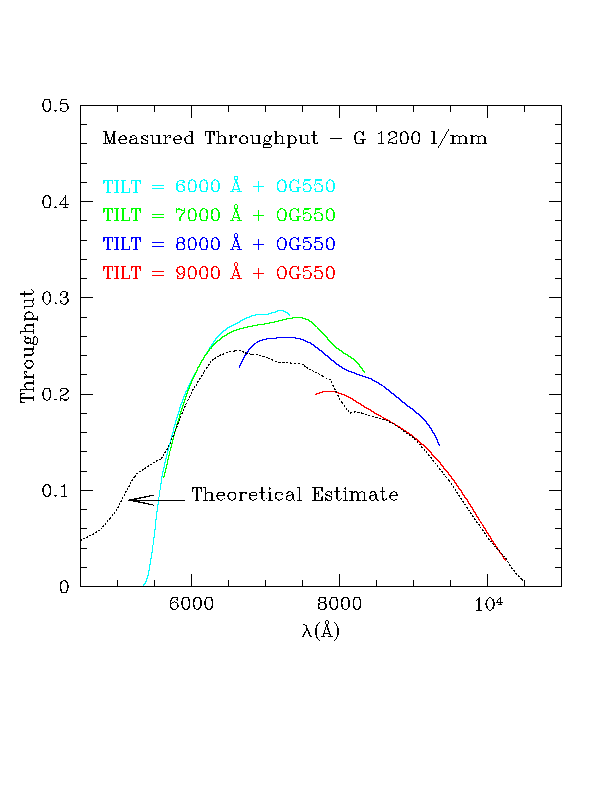
Gold 830 l/mm: download ps view plot
Gold
1200 l/mm: download
ps view
plot
MODEL THROUGHPUT
We also made a theoretical throughput estimate for each of the grating/filter
settings,
which is compared to the data in some of the Figures above. This model
throughput is the
result of the product of the efficiencies of all the components in the
optical path from the
telescope's primary mirror, down to the CCD:
Throughput = Telescope_Mirrors * Front_Window * Collimator * Tent_Mirror
*
Camera * Grating * CCD
We give more details below on the input data for each of the components
above:
1) Telescope Mirrors
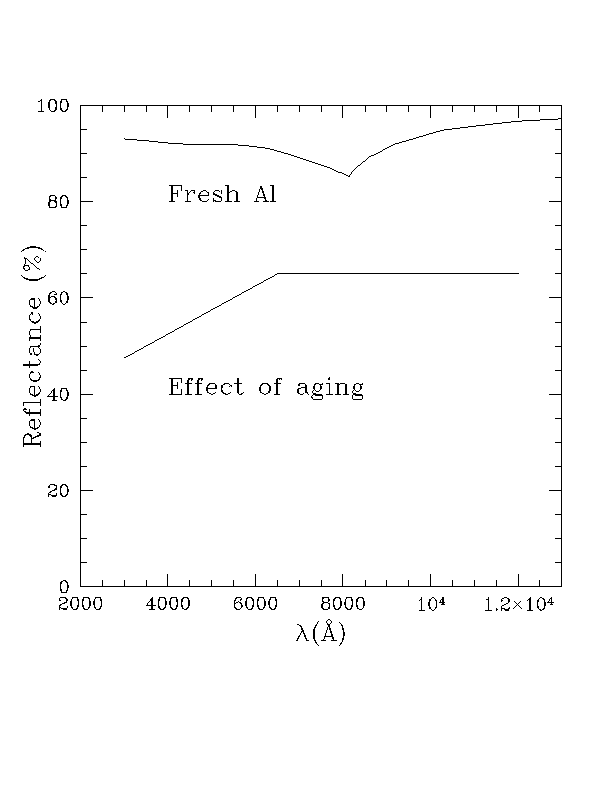
The Keck telescope mirrors are aluminum-coated. We adopted a reflectivity
curve
for fresh aluminum taken from Thermo
Oriel. Aluminum gets old, though, mostly due to
oxidation and dust accumulation, and this has a large impact on its reflecting
properties.
We accounted for the aging effect by following a prescription suggested
by Mike Bolte. In
Figure 1 we show a plot of the fresh aluminum
reflectance as a function of wavelength, and
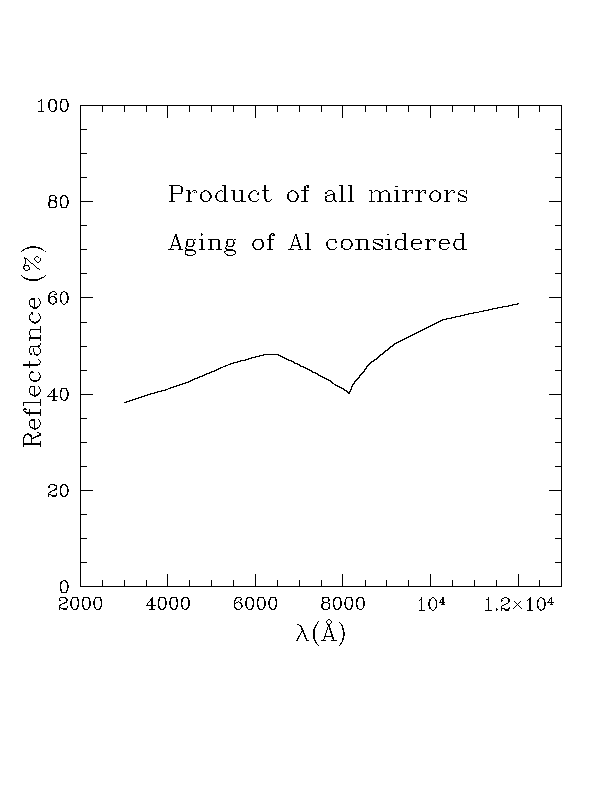
the multiplicative factor applied to that curve to account for aging. In
Figure
2, we display
the final reflectance curve adopted for the combination of the three Keck
mirrors, taking
into account the aging effect. Admittedly, the above correction for the
aging effect is quite
crude. Therefore, the final reflectance shown in Figure 2 needs to be taken
with a grain of
salt. For instance, measurements by Bill Brown, from Lick, show that just
washing the mirrors
can boost the reflectance by up to 10%, so that periodic variations as
large as that are to be
expected.
2) DEIMOS Front Window
3) Collimator
4) Tent Window
5) Camera
6) Gratings
7) CCDs