Telescopes of the Lick Observatory
UCO home > Public Information > Telescopes
 Lick Telescope Table of Contents

- Telescope & Instrument Overview
- Telescopes: Gathering Light
- Refractors vs. Reflectors
- Cameras & CCDs: Recording Light
- Home digital camera CCDs vs. Astronomical CCDs
- Spectrographs: Analyzing Light
- Adaptive Optics: New Tools
- Infrared Observation: New Methods
- Telescope & Instrument Details
- Great Lick Refractor
- Crossley Reflector
- Carnegie Double Astrograph
- Shane 120-inch Reflector
- Nickel 1-meter Reflector
- KAIT: Katzman Automatic Imaging Telescope
- APF: Automated Planet Finder
Telescopes: Gathering Light
Telescopes enable astronomers to gather light from distant celestial objects using a series of lenses and/or mirrors. Early astronomers observed this light directly from the telescope's eyepiece. Nowadays, the gathered light is passed into auxiliary instruments where it can be studied in detail. By analyzing the light, astronomers strive to learn about the nature of the celestial objects that produced it.
Refractors vs. Reflectors
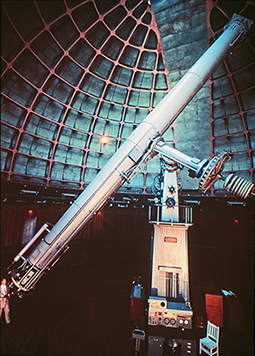 Refracting telescopes (refractors), like gigantic spyglasses, use clear glass lenses to bend (refract) light rays into a focused image of the object being studied. At least two lenses, located at the end of the telescope opposite the eyepiece, must be used to make a focused image. As light passes through the first lens, the colors of light separate, similar sunlight passing through a prism. Another lens or lenses are needed to lessen this chromatic aberration and and sharpen the image. Refractors are typically built such that the telescope tube length is long compared with their lens diameter, or aperture.
The maximum size of a refractor is limited to an aperture of about 40 inches. A lens much larger than this will slump and deform under its own weight. This lens can only be supported around the edges and cannot be reinforced by a backing structure, since light must pass through it. It is technically very difficult to cast perfectly clear disks of glass of this size. Building, supporting, and housing the proportionately long telescope tubes refracting telescopes require are additional challenges.
Reflecting telescopes (reflectors) use a precisely curved mirror, located at the dome floor end of the telescope. This mirror reflects and focuses light at the sky end of the telescope tube, where the eyepiece was traditionally located. Nowadays, the eyepiece has been replaced by a variety of instruments in conjunction with computers, and astronomers observe from a control room which may be adjacent or many miles away. Other mirrors inside the telescope may reflect the light to alternative focus locations (foci), where specialized instruments are located. See the Shane telescope webpage for further discussion of different foci and their associated instruments.
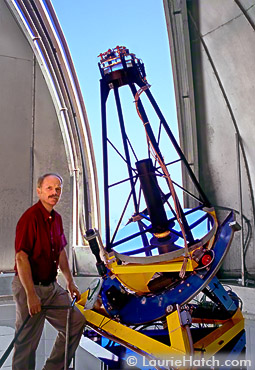 Reflectors solve many of the problems inherent in refractors. Because reflectors use a mirror at the base end of the telescope, the mirror can be supported from below, unlike the lenses at the top of a refracting telescope tube. More support means that larger aperture (mirror diameter) telescopes can be built. In addition, reflecting the light rather than refracting it eliminates the chromatic aberrations of light passing through a lens. The object of study appears less distorted, and additional correctional lenses are not needed. Elimination of the lenses also decreases the length that a telescope tube needs to be. Decreasing the size of the tube reduces the cost and technical challenges of building the both telescope and its dome.
The glass of a reflector's mirror does not need to be as free of optical distortion than the lens glass of a refracto, since the light does not pass through it.. Only the surface of the mirror needs to be perfect. So casting mirror glass is less technically challenging than casting lens glass. Of course, the mirror surface must be painstakingly ground and polished to perfection and the reflective aluminum mirror surface carefully applied. Single mirrors as large as 330 inches have been cast. Even larger reflectors have been built using multiple mirrors nested in a mosaic. The Keck twin reflectors, for example, each use a mosaic of 36 hexagonal mirrors to provide an aperture of 10 meters, or 393.7 inches! Even larger reflectors are now being designed, most notably the Thirty Meter Telescope (TMT). Larger apertures mean more light can be gathered, so fainter objects may be detected and studied.
Cameras & CCDs: Recording Light
In the late 1800s, A.A. Common, using the Crossley Reflector, discovered that astronomers could see more detail in the night sky in photographs than they could by direct observation. Similar to making a time-exposure with a camera, more light can be gathered and recorded over a period of time than the eye can see. Glass plates covered with photographic emulsion were used with telescopes much like film is used in cameras. The longer the photographic plate was exposed, the more light was recorded. Many thousands of photographic glass plates have been produced at Lick Observatory, using the Great Lick Refractor, Carnegie Astrograph, and Shane Reflector, as well as the Crossley Reflector.
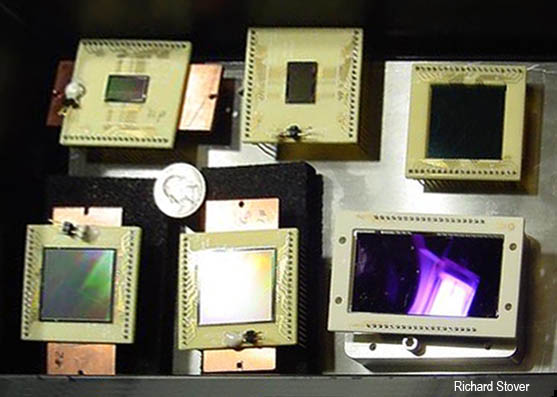 Nowadays, charge-coupled devices (CCDs) are used to record the light from observed objects which the telescope gathers, replacing both photographic plates and film. CCDs are used in home digital cameras as well as astronomical cameras and spectrographs. CCDs produce electrical charges in response to light, recording light much more sensitively than photographic emulsion. Hundreds of thousands (sometimes millions) of light-sensitive cells (pixels) cover the CCD surface. Each pixel is capable of recording many single photons, the smallest unit of light, by producing an electrical charge for each photon. Each pixel develops a total charge that represents the number of photons of light that it has detected. After an observation, a computer records the amount of electrical charge in each pixel, producing a map of the number and distribution of photons detected. This map creates a very precise, high resolution image of the object observed.
Astronomical CCDs differ from CCDs in digital cameras in several important ways. Astronomical CCDs:
- Collect the light that reaches them more efficiently
- Are sensitive to a broader range of colors
- Do not incorporate filters used by digital cameras because this restricts the colors that can be studied
- Are designed to operate with much lower electronic noise to make it possible to observe very faint objects
- Operate at very low temperature (around -85 degrees F) which makes it possible to make very long exposures of up to a hour or more
- Are often larger than typical home digital camera CCDs
By astronomical standards, a 10 megapixel CCD is small. Astronomical CCDs in the range of 500-1000 megapixels are commonly constructed.
Because CCDs are most sensitive in the near-ultraviolet to near-infrared range, CCD cameras record mostly visible light plus some ultraviolet and infrared radiation. High-sensitivity infrared (IR) CCDs are being pioneered at UC Berkeley Labs in conjunction with Lawrence Livermore Labs, to accommodate growing interest in IR observation and imaging. These new CCDs will increase image resolution by a factor of 10.
The CCDs pictured above were built in the UCO CCD lab located at University of California Santa Cruz. Note the relative size of the quarter.
Spectrographs: Analyzing Light
 Spectroscopes analyze light by spreading it into its parts or spectrum, similar to sunlight shining through a prism. Spectrographs are spectroscopes that also produces a recorded image of the spectrum.
Spectrographs record light (using CCDs), spreading it into its constituent components, and draw a spectrum for the observed object. Spectra obtained at Lick Observatory include the visible colors plus invisible extensions, particularly infrared. The spectrum of an object shows its unique pattern of energy at each wavelength.
Dark and bright lines appear on an object's spectrum, indicating absorption and emission of energy by chemical elements within the object. By studying the size, shape, and distribution of these lines, astronomers can determine characteristics of the object such as its temperature, chemical composition, and velocity, and whether it is moving towards or away from Earth.
The spectrum of the sun above was generated by synthesizing data recorded with the Fourier Transform Spectrometer at Kitt Peak National Observatory. Image credit: N.A. Sharp, NOAO/NSO/Kitt Peak FTS/AURA/NSF. Spectra of more remote stars have many more dark lines.
New Tools: Adaptive Optics
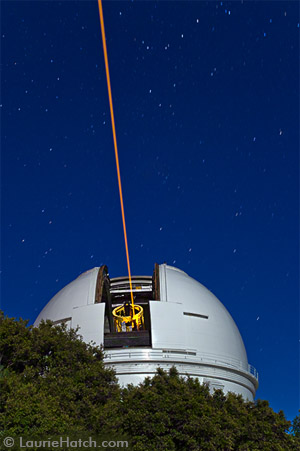 The turbulence of the earth's atmosphere creates an inherent problem for earth-based observations. Because the atmosphere is not uniform, pockets of varying density air bend (refract) the light from observed objects. This causes the familiar "twinkle" of stars. While poetic, this twinkling creates havoc with observations which are recorded over a period of time, in effect blurring the image.
Adaptive optics (AO) systems detect and measure how the blurring is affecting the image, and warp an auxiliary mirror to compensate for this blur. The deformable telescope mirror is almost infinitely adjustable. It changes shape in numerous places many times per second, compensating for changing atmospheric conditions to focus light precisely.
Lick Observatory engineered the first astronomical Laser Guide Star (LGS, or AO LGS) system, making adaptive optics more practical. Before correcting the blurring of an observed object, AO systems must measure the atmospheric distortion. Sometimes a nearby bright star can be used as a "guide star," to measure this distortion. More often, no bright star is near enough to the object to be observed. The Lick LGS system actually creates a guide "star" by shooting a laser beam into the sky, making sodium ions in the upper atmospere glow. The atmospheric distortion is measured using this manmade "star," and the deformable mirror is adjusted accordingly to get a clear view of the observed object. This system is now being used at observatories throughout the world.
Please see the Adaptive Optics webpage for more details about AO engineering and observation at Lick Observatory.
New Methods: Infrared Observation
Light pollution, or light from communities and industries adjacent to observatories that reduces the accuracy of observation, is an increasing problem throughout the world today. Astronomers are increasingly interested in infrared (IR) observation, which measures wavelengths that we perceive as heat, because there is less earth-based "pollution" in this area of the spectrum. Many new IR cameras and spectrographs are being designed and built.
Mt. Hamilton is less light-polluted than many observatories, thanks to the city of San Jose. San Jose employs low-pressure sodium vapor streetlights which "pollute" only one small area of the spectrum. However, the night sky over Mt. Hamilton is even more "dark" (without interference) in the IR range.
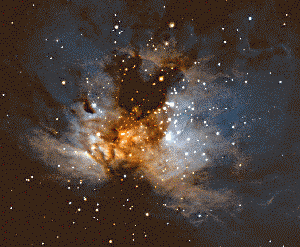 Many astronomical processes create IR radiation that can be observed and analyzed. Examples include star formation, forming and colliding galaxies, novae and supernovae, and the event horizons of black holes. Astronomers can quantify IR radiation from around "room temperature" to several thousand degrees above absolute zero.
IR radiation also penetrates cosmic dust clouds more easily than visible light. This makes IR observation superior to visible light observation if the process itself is dusty, such as star formation The image to the left reveals a dense cluster of young stars (reddish region in center) which is obscured at visible wavelengths by the nebula's dark central dust lane. (NGC 2024 image courtesy Ian McLean and UCLA IR Lab.) IR observation is also practical for observing remote objects when there are cosmic dust clouds between the object observed and the observer.
The now-retired Lick Infrared Camera (LIRC-II) was an early pioneeer in IR imaging, used at the Cassegrain foci of both the Shane and Nickel telescopes. The Gemini IR Imaging Camera, built at UCLA Infrared Labs, is currently used with the Shane telescope. IR-sensitive instruments are being built for Adaptive Optics (AO), and IR-sensitive CCDs are being developed. Clearly, IR observation and imaging will be widely used in future research at Lick Observatory, and throughout the world.