Telescopes of the Lick Observatory
UCO home > Public Information > Telescopes > Anna L. Nickel Telescope
Nickel Telescope
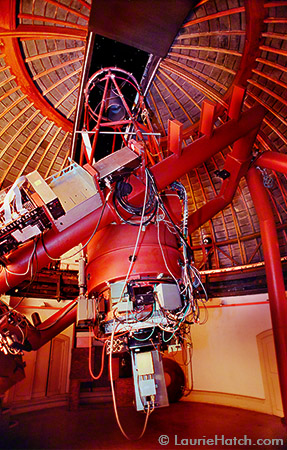 The Shane 120-inch telescope has been an extremely popular research telescope since it was built in 1959. Lick astronomers had wanted to build a smaller reflector to share the demand for telescope time. They were able to achieve this goal when San Francisco seamstress Anna L. Nickel bequeathed a large part of her estate to the Lick Observatory in the late 1970s. These funds were used to build a 40-inch (1-m) reflecting telescope. While it was estimated that such a telescope would cost $750,000, and just $50,000 had been donated, Lick Observatory ingenuity and adeptness at recycling kept the total spent on parts at only $28,000. Dubbed by some the "spare parts telescope," the Nickel was built around a 40-inch mirror originally acquired for the Crossley telescope, and utilized many other on-hand parts. By building "in-house" at the UCO Technical Facilities at UCSC, an estimated $400,000 of labor was provided as a part of regular shop operations. The Nickel telescope was completed in 1979.
Because the Nickel 40-inch reflector was to occupy the smaller dome of the Main Building, which had been designed to house the much smaller Clark 12-inch reflector, careful engineering was necessary. The height of the dome and the size of the slit were carefully considered. A simple mounting of minimal size and weight was designed and built. The movement of the dome, which keeps the slit directly above the telescope, was computer-controlled.
In another economizing effort, the Nickel telescope was designed with the same optical characteristics as the Cassegrain focus of the Shane telescope. Thus the two telescopes can use the same instruments. Telescope technicians can use the Nickel to test instruments for the larger and more popular Shane telescope.
The 40-inch Nickel reflector is used in astronomical projects that require less light-gathering power than the 120-inch Shane reflector. University of California graduate students often use the Nickel, which is operated from a computerized control room nearby. The public may both look through the Nickel telescope and see the control room at the Lick Observatory Summer Visitors Program and the Music of the Spheres summer concert program.
OSETI Instruments
OSETI (Optical Search for Extraterrestrial Intelligence) researchers use the Nickel telescope to search for very brief bursts of optical light, which might be an attempt by an extraterrestrial civilization to indicate their presence to us.
OSETI researchers use a sensitive and very fast triple photometer (light or photon measuring instrument) located at the Cassegrain focus (lower end) of the Nickel telescope Lick Observatory. They mostly target nearby stars with a presumed lifetime long enough to have allowed evolution of complex life. This photometer is pictured at the Cassegrain focus of the telescope in the photo above.
Use of a triple photometer eliminates many false positive signals. The larger the photon pulse, the greater the chance it was not an accidental coincidence, but rather an intentional extraterrestrial signal. If the photon event is seen in only one or two detectors, researchers ignore it as a false positive. If researchers see a photon flux large enough to trigger all three detectors within the same one-billionth of a second, only rarely would this be a false positive. When observed in all three detectors, a signal is more likely to be an intentional one, which merits the time and effort necessary to make a confirming observation.
For more information, please go to http://seti.ucolick.org/optical/
CCD Camera
A CCD Camera is located at the Cassegrain focus of the Nickel telescope. It operates similarly to the Shane telescope's Prime Focus Camera (PFCam), using CCDs to record light in the near-ultraviolet to near-infrared range, including the entire visible light range. Because the Cassegrain focus of Nickel telescope has less light-gathering ability than the prime focus of the Shane telescope, this camera is used to photograph brighter objects than the Prime Focus Camera.
Nickel Spectrograph
A standard single-beam spectrograph is located at Cassegrain focus of the Nickel telescope. It operates similarly to the Kast spectrograph on the Shane telescope, but with considerably less sensitivity, because the Kast produces two specialized spectra that are then combined. The Nickel spectrograph produces useful spectra from brighter celestial objects.