Telescopes of the Lick Observatory
UCO home > Public Information > Telescopes > Shane 120-inch Reflector
Shane Telescope Table of Contents
Overview of Shane Telescope
Prime Focus
Prime Focus Instruments
Cassegrain Focus
Cassegrain Focus Instruments
Coudé Focus
Coudé Focus Instruments
Coudé Auxiliary Telescope
Laser Beams from the Shane Dome
Shane Telescope Overview
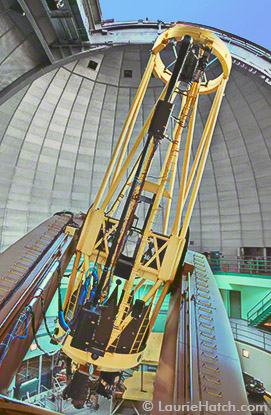 UCO celebrated 50 years of Shane telescope observation in 2009! Commissioned in 1959, this telescope was named in honor of C. Donald Shane, Lick Observatory Director during its design and construction. For many years it was the second-largest reflector in the world. The Shane's adaptable 3-foci design (detailed below) allows many kinds of instruments to be used, enabling a large variety of observations and research. Instrumentation has been kept current throughout the years, largely designed and built by UCO's technical facilities. The Shane telescope is used for research almost every night of the year.
The 3-foci design works as follows: The telescope is constructed around a 120-inch primary mirror. Light can be focused at three different locations (foci) along the length of the telescope: prime focus, Cassegrain focus, and coudé focus. Designed for maximum versatility, the three foci accommodate a variety of instruments for many different types of research. UCO astronomers often refer to this telescope as the 120-inch or the 3-meter, based upon the diameter of its primary mirror.
The heart of the Shane telescope, the 120-inch primary mirror, was originally a glass test blank cast in Corning Labs for Palomar Observatory's 200-inch reflector. Pyrex, the well known "cooking glass," was actually invented to make these telescope mirrors. Caltech sold the 120-inch blank to Lick Observatory at the nominal cost of $50,000, well below the cost of fabricating new mirror glass. Cast 17 inches deep and weighing 10,000 lbs, the glass was carefully transported to Mt. Hamilton using two flatbed trucks and a crane. On each hairpin turn where technicians thought the glass could shift and break on the flatbed, the glass was lifted by crane from one truck, located below the turn, to the other, located above the turn.
Once on Mt. Hamilton, UCO technicians precisely ground and polished the mirror into a shallow and uniform dish. It is estimated that 95% of the shaping, in terms of glass removed, took place during the first 80 hours, and the remaining 5% during the next 4 years. In the end, 600 lbs of glass had been removed, resulting in a 4.5 ton piece of glass with a shallow dish shape measuring ten feet in diameter but only 1.5 inches deep in the center.
 |
 |
 |
The glass was then aluminized, or coated with a reflective surface of aluminum, to become a mirror. First the glass was cleaned thoroughly. Then the glass was coated with vaporized aluminum in a vacuum chamber in the basement of the Shane dome. A very thin coating of vaporized aluminum settled on the concave surface--about as thick as the moisture left by breath on a cold window. Only about .5 ounces (the weight of a soda can) is deposited over the entire 3-meter mirror surface. When on the telescope, the mirror is protected with a custom mirror cover that is mechanically removed during observing times. Even with this protection, the mirror must be cleaned and re-aluminized about every five years to maintain optimum reflectivity to clearly observe celestial objects.
Prime Focus
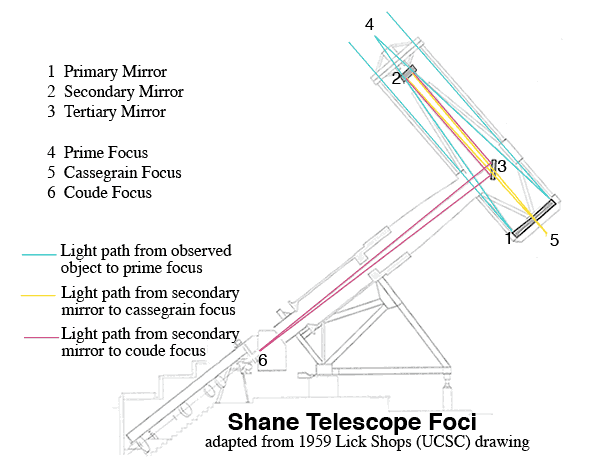 The prime focus is located at the top end of the telescope. Light from a celestial object enters the telescope through the top, and bounces off the primary mirror at the bottom then back up to the prime focus (see diagram on right). Originally, astronomers observed directly through an eyepiece at prime focus. Astronomers spent hours in an unheated observers' cage 60 feet above the observatory floor. Heat near the telescope will distort the view of the sky, similar to heat waves creating a mirage in the desert, so observers were forced to endure cold conditions to accomplish their research.
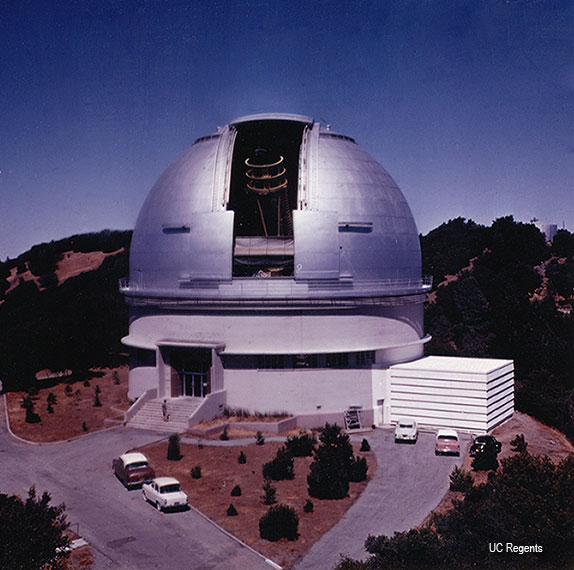
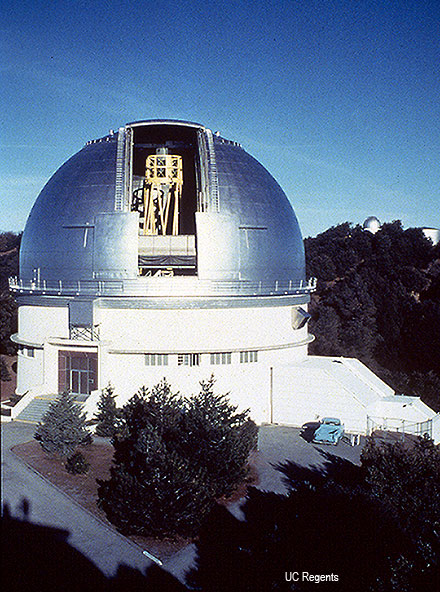
Nowadays observations are made remotely, using computers in a heated control room adjacent to the telescope, and the observers' cage has been retired. Note that you can see the observers cage at the top of the telescope in the 1960 and 1980 Shane dome photos above, but not in 2004 photo.
Since they sit on top of the telescope, prime focus instruments must be quite small to avoid blocking light from entering the telescope. Notice in the 3 foci illustration above that the light path from the observed object to prime focus is shorter than the light path to the other foci, which means that light is concentrated most intensely at prime focus. Notice also that light at prime focus has been reflected from only one mirror. Because each mirror reduces the amount of light gathered by 10-15%, prime focus instruments also receive the most light. For these reasons, prime focus instruments are typically used to view the faintest objects. Instruments at prime focus also view the widest area of the sky. Thus they are used to observe very faint objects over a wide field of view, such as a cluster of galaxies at the end of the universe. The main prime focus instrument used today is the prime focus camera.
Prime Focus Instruments
Prime Focus Camera
The Prime Focus Camera (PFCam) uses CCDs to record light at the Shane telescope’s prime focus. Like most astronomical CCD cameras, PFCam records visible light plus some ultraviolet and infrared radiation—the wavelengths at which most CCDs have maximum sensitivity. PFCam is primarily used to record faint objects, such as distant galaxies, over a wide field of view. See the telescope index webpage for a discussion of astronomical cameras and the differences between astronomical and home camera CCDs.
 Cassegrain Focus
The design for Cassegrain telescopes was first published by Laurent Cassegrain in 1672. Cassegrain focus is located at the bottom end of the telescope. Light enters the telescope from the top and bounces off the primary mirror. Then light reflects off a secondary mirror near the prime focus, and back down, focusing just below the primary mirror (see diagram of 3 foci). Since the light path to Cassegrain focus is longer than the light path to prime focus (longer focal length), the light received at Cassegrain focus is less concentrated. Also, the secondary mirror reduces the light by another 10-15%, so Cassegrain focus instruments are often used to observe moderately bright objects.
Cassegrain instruments are suspended from the bottom of the telescope, and can be relatively large for two reasons. A Cassegrain instrument will not block the light coming into the telescope like instruments at prime focus. Also, since Cassegrain instruments are located near the dome floor, they are more convenient to install and service than prime focus instruments. Many Cassegrain instruments have been constructed during the Shane telescope's lifetime. Current Cassegrain focus instruments include the Kast Spectrograph and the Gemini Infrared Imaging Camera.
Cassegrain Instruments
Kast Double-Beam Spectrograph
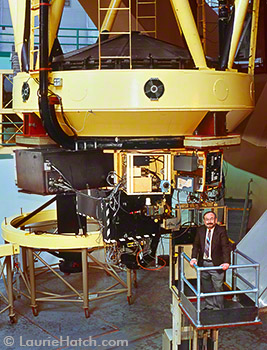
Used at the Cassegrain focus of the Shane telescope, the Kast spectrograph is actually two complete spectrographs, optimized for different areas of the spectrum. Most spectrographs are sensitive only in one area. The Kast uses two separate CCDs to analyze and record wavelengths in the blue and red ranges independently and simultaneously. The red and blue spectra are then combined to form a spectrum complete in all visible wavelengths. The Kast also can also produce images of celestial objects, and is often used for analyzing relatively faint objects.
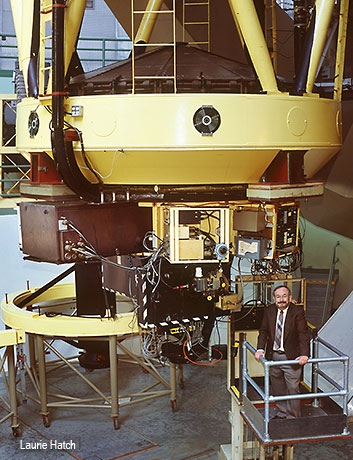
The photograph above shows the Kast spectrograph suspended at the Cassegrain focus of the Shane, with its designer, former UCO Director Joe Miller.
The Kast Spectrograph has been used for many years to research chemical compositions of stars. Other research for which it is employed includes study of massive intergalactic hydrogen clouds and analysis of distant radio galaxies.
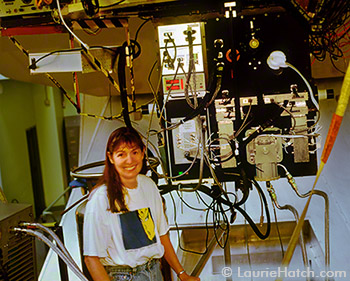 Gemini Infrared Imaging Camera
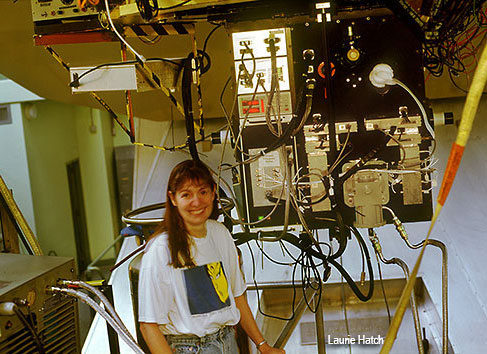
Built in the UCLA Infrared Imaging Detector Lab, this Infrared (IR) camera is used frequently at the Cassegrain focus of the Shane telescope. An innovative beam-splitter increases observing efficiency by allowing astronomers to detect and record two wavelengths at once, rather than making two separate exposures. Gemini is also capable of low-resolution spectroscopy.
The Gemini camera is currently used to observe stars that do not emit enough visible light to be imaged well with conventional visible light sensitive cameras. For example, brown dwarfs and other low mass stars are observed with Gemini. It has a wide range of potential use in future research. It is pictured at the right with Lick Observatory support scientist Ellie Gates.
Coudé Focus
Sometimes astronomers want to build instruments too large and heavy to be used at Cassegrain focus. These are typically high-dispersion spectrographs, which spread the light received into its component colors. Such spectrographs require a large physical space. Coudé focus instruments are not attached to the telescope at all, and not even located in the same room as the telescope. Located below the Shane dome floor, they can be nearly unlimited in size and weight. The Hamilton Echelle Spectrograph now occupies two entire rooms in the Shane dome basement!
At coudé focus, light from the observed object is focused below the Shane dome floor. A different secondary mirror than the one used at Cassegrain focus is required, along with a third mirror. The Shane 3 foci illustration above shows that the light path is much longer than the light path to the prime focus, so considerably less light can be concentrated at coudé focus. Also, the additional mirrors needed to bring light to coudé focus also reduce the amount of light received here. Because of these factors, coudé focus instruments are used primarily to observe relatively bright objects. Various coudé spectrographs have been used throughout the years. The Hamilton Echelle Spectrograph is now used at coudé focus.
Coudé Instruments
Hamilton Echelle Spectrograph

Unlike most spectrographs, which spread light into a single band of color components, the Hamilton is a high-dispersion instrument, spreading light into an echelle spectrum, or ladder-like arrangement of about 80 bands. Each band represents a precise picture of a small wavelength (color) range. Together the bands create a comprehensive yet highly detailed representation of the observed object.
Occupying two rooms below the Shane dome floor, and used by both the Shane telescope (at coudé focus) and the Coudé Auxiliary Telescope (see below), the Hamilton Echelle Spectrograph is used mostly to study bright objects.
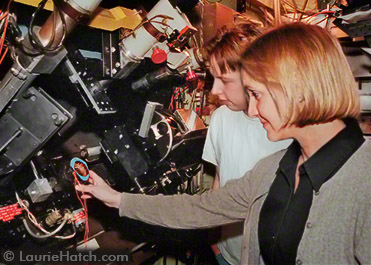
The Hamilton Echelle Spectrograph is currently used in detecting extrasolar planets, determining chemical composition of stars, and other research. In the photograph on the right, planet hunter Debra Fischer checks the iodine cell before an extrasolar planet observation. As starlight passes through this glass cell, fine iodine lines are imprinted on the stellar spectrum. The stellar lines will shift if the star has a planet, and the iodine lines serve as a stationary grid with which to measure these shifts.
The Coudé Auxiliary Telescope
The Coudé Auxiliary Telescope (CAT) was built in 1969 to maximize use of the Hamilton Echelle Spectrograph. The CAT can be used to observe with the Hamilton Echelle spectrograph during any time that Shane telescope observers are using Cassegrain or prime focus instruments. The 24-inch CAT reflecting telescope is mounted in a stationary position at a fixed focus in a metal building adjacent to the Shane dome. This building can be seen on the right side in the Shane dome photos taken in 2004 and 1980, but not in 1960 photo. A flat mirror directs light from the observed object to the CAT, which in turn beams the light to the Hamilton Echelle spectrograph.
Since the 24-inch CAT gathers much less light than the 120-inch Shane, the CAT is typically used to observe brighter stars. The CAT is often used in projects which require many nights of observation or large samples of stars, leaving the more popular Shane telescope available for research that requires less frequent observing time.
Laser Beams from the Shane Dome
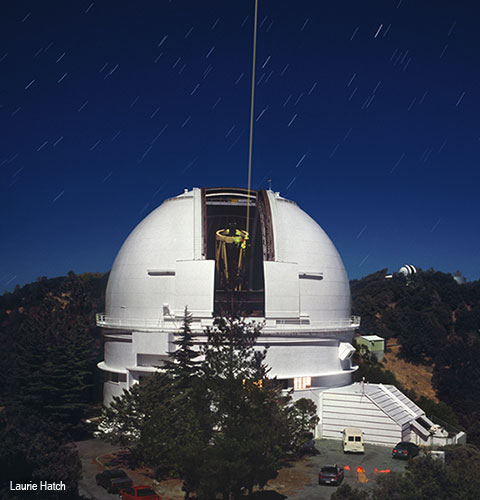
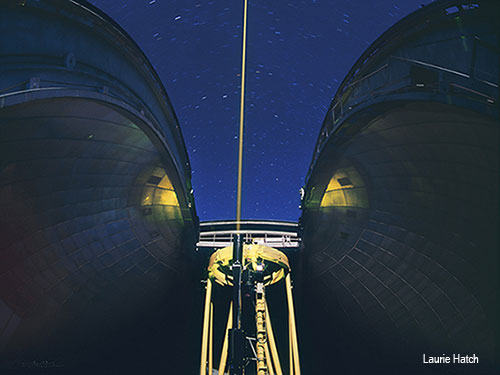 The 2004 Shane dome photo above shows a laser beam being shot from the dome. This is part of the Lick Observatory adaptive optics system. Lick was the first observatory in the world to engineer this laser guide star (LGS) system, which is now used in observatories throughout the world. The photo on the left shows a closer view of the laser tube mechanism at the top of the telescope.
Adaptive optics (AO) systems focus telescopes images precisely by compensating for the earth's unstable atmosphere, which makes stars "twinkle." As you might imagine, the "twinkle" will cause the image of an observed object to be blurry. AO eliminates this by bending the telescope mirror many times per second to focus the observed image and compensate for atmospheric instability.
The adaptive optics system must detect and quantify the distortion caused by the atmosphere in order to compensate for it. Sometimes a bright star is located in the sky nearby the observed object. This star can be used as a "guide star" to quantify the corrections in focus needed.
More often, there is no bright star nearby, so Lick astronomers actually create one. The laser from the Shane instrument excites sodium ions in the upper atmosphere until they glow, creating a laser guide "star." This "star" is then used to detect and quantify the adjustments needed to observe the nearby object with optimum clarity.
Please see the Adaptive Optics webpage for more details about adaptive optics engineering and observation at Lick Observatory.